 Add to Chrome
 Add to Firefox
 Add to Edge
Face Reenactment
Face reenactment is the process of transferring facial expressions from one person to another in videos.
Papers and Code
Micro-Expression-Aware Avatar Fingerprinting via Inter-Frame Feature Differencing
Apr 25, 2026
Avatar fingerprinting, i.e., verifying who drives a synthetic talking-head video rather than whether it is real, is a critical safeguard for authorized use of face-reenactment technology. Existing methods rely on a fixed, non-differentiable landmark extraction stage that prevents the fingerprinting model from being optimized end-to-end from raw pixels. We propose a preprocessing-free system built on a micro-expression-aware backbone operating on raw video frames, with inter-frame feature differencing as the core design principle: consecutive feature maps are subtracted in the learned deep feature space, so that temporally stable appearance dimensions contribute zero to the output while driver-specific motion dynamics are preserved. A controlled ablation on NVFAIR confirms that temporal motion accounts for the large majority of discriminative performance, and that raw appearance features actively degrade identity separation. Both the choice of backbone and the differencing principle are essential: differencing alone is insufficient when applied to a generic encoder, as appearance-dominated features collapse to near-identical representations across adjacent frames, while the micro-expression-aware F5C backbone retains measurable motion variation that the differencing operation can exploit. Without any external preprocessing, our model achieves an overall AUC of 0.877 on NVFAIR and matches or exceeds the landmark-based baseline on the majority of cross-generator pairs.

PortraitDirector: A Hierarchical Disentanglement Framework for Controllable and Real-time Facial Reenactment
Apr 21, 2026Existing facial reenactment methods struggle with a trade-off between expressiveness and fine-grained controllability. Holistic facial reenactment models often sacrifice granular control for expressiveness, while methods designed for control may struggle with fidelity and robust disentanglement. Instead of treating facial motion as a monolithic signal, we explore an alternative compositional perspective. In this paper, we introduce PortraitDirector, a novel framework that formulates face reenactment as a hierarchical composition task, achieving high-fidelity and controllable results. We employ a Hierarchical Motion Disentanglement and Composition strategy, deconstructing facial motion into a Spatial Layer for physical movements and a Semantic Layer for emotional content. The Spatial Layer comprises: (i) global head pose, managed via a dedicated representation and injection pathway; (ii) spatially separated local facial expressions, distilled from cropped facial regions and purged of emotional cues via Emotion-Filtering Module leveraging an information bottleneck. The Semantic Layer contains a derived global emotion. The disentangled components are then recomposed into an expressive motion latent. Furthermore, we engineer the framework for real-time performance through a suite of optimizations, including diffusion distillation, causal attention and VAE acceleration. PortraitDirector achieves streaming, high-fidelity, controllable 512 x 512 face reenactment at 20 FPS with a end-to-end 800 ms latency on a single 5090 GPU.
Giving Faces Their Feelings Back: Explicit Emotion Control for Feedforward Single-Image 3D Head Avatars
Apr 16, 2026We present a framework for explicit emotion control in feed-forward, single-image 3D head avatar reconstruction. Unlike existing pipelines where emotion is implicitly entangled with geometry or appearance, we treat emotion as a first-class control signal that can be manipulated independently and consistently across identities. Our method injects emotion into existing feed-forward architectures via a dual-path modulation mechanism without modifying their core design. Geometry modulation performs emotion-conditioned normalization in the original parametric space, disentangling emotional state from speech-driven articulation, while appearance modulation captures identity-aware, emotion-dependent visual cues beyond geometry. To enable learning under this setting, we construct a time-synchronized, emotion-consistent multi-identity dataset by transferring aligned emotional dynamics across identities. Integrated into multiple state-of-the-art backbones, our framework preserves reconstruction and reenactment fidelity while enabling controllable emotion transfer, disentangled manipulation, and smooth emotion interpolation, advancing expressive and scalable 3D head avatars.
UniBioTransfer: A Unified Framework for Multiple Biometrics Transfer
Mar 20, 2026Deepface generation has traditionally followed a task-driven paradigm, where distinct tasks (e.g., face transfer and hair transfer) are addressed by task-specific models. Nevertheless, this single-task setting severely limits model generalization and scalability. A unified model capable of solving multiple deepface generation tasks in a single pass represents a promising and practical direction, yet remains challenging due to data scarcity and cross-task conflicts arising from heterogeneous attribute transformations. To this end, we propose UniBioTransfer, the first unified framework capable of handling both conventional deepface tasks (e.g., face transfer and face reenactment) and shape-varying transformations (e.g., hair transfer and head transfer). Besides, UniBioTransfer naturally generalizes to unseen tasks, like lip, eye, and glasses transfer, with minimal fine-tuning. Generally, UniBioTransfer addresses data insufficiency in multi-task generation through a unified data construction strategy, including a swapping-based corruption mechanism designed for spatially dynamic attributes like hair. It further mitigates cross-task interference via an innovative BioMoE, a mixture-of-experts based model coupled with a novel two-stage training strategy that effectively disentangles task-specific knowledge. Extensive experiments demonstrate the effectiveness, generalization, and scalability of UniBioTransfer, outperforming both existing unified models and task-specific methods across a wide range of deepface generation tasks. Project page is at https://scy639.github.io/UniBioTransfer.github.io/
SelfieAvatar: Real-time Head Avatar reenactment from a Selfie Video
Jan 26, 2026Head avatar reenactment focuses on creating animatable personal avatars from monocular videos, serving as a foundational element for applications like social signal understanding, gaming, human-machine interaction, and computer vision. Recent advances in 3D Morphable Model (3DMM)-based facial reconstruction methods have achieved remarkable high-fidelity face estimation. However, on the one hand, they struggle to capture the entire head, including non-facial regions and background details in real time, which is an essential aspect for producing realistic, high-fidelity head avatars. On the other hand, recent approaches leveraging generative adversarial networks (GANs) for head avatar generation from videos can achieve high-quality reenactments but encounter limitations in reproducing fine-grained head details, such as wrinkles and hair textures. In addition, existing methods generally rely on a large amount of training data, and rarely focus on using only a simple selfie video to achieve avatar reenactment. To address these challenges, this study introduces a method for detailed head avatar reenactment using a selfie video. The approach combines 3DMMs with a StyleGAN-based generator. A detailed reconstruction model is proposed, incorporating mixed loss functions for foreground reconstruction and avatar image generation during adversarial training to recover high-frequency details. Qualitative and quantitative evaluations on self-reenactment and cross-reenactment tasks demonstrate that the proposed method achieves superior head avatar reconstruction with rich and intricate textures compared to existing approaches.
DeepfakeBench-MM: A Comprehensive Benchmark for Multimodal Deepfake Detection
Oct 26, 2025The misuse of advanced generative AI models has resulted in the widespread proliferation of falsified data, particularly forged human-centric audiovisual content, which poses substantial societal risks (e.g., financial fraud and social instability). In response to this growing threat, several works have preliminarily explored countermeasures. However, the lack of sufficient and diverse training data, along with the absence of a standardized benchmark, hinder deeper exploration. To address this challenge, we first build Mega-MMDF, a large-scale, diverse, and high-quality dataset for multimodal deepfake detection. Specifically, we employ 21 forgery pipelines through the combination of 10 audio forgery methods, 12 visual forgery methods, and 6 audio-driven face reenactment methods. Mega-MMDF currently contains 0.1 million real samples and 1.1 million forged samples, making it one of the largest and most diverse multimodal deepfake datasets, with plans for continuous expansion. Building on it, we present DeepfakeBench-MM, the first unified benchmark for multimodal deepfake detection. It establishes standardized protocols across the entire detection pipeline and serves as a versatile platform for evaluating existing methods as well as exploring novel approaches. DeepfakeBench-MM currently supports 5 datasets and 11 multimodal deepfake detectors. Furthermore, our comprehensive evaluations and in-depth analyses uncover several key findings from multiple perspectives (e.g., augmentation, stacked forgery). We believe that DeepfakeBench-MM, together with our large-scale Mega-MMDF, will serve as foundational infrastructures for advancing multimodal deepfake detection.
Improving Generalization in Deepfake Detection with Face Foundation Models and Metric Learning
Aug 27, 2025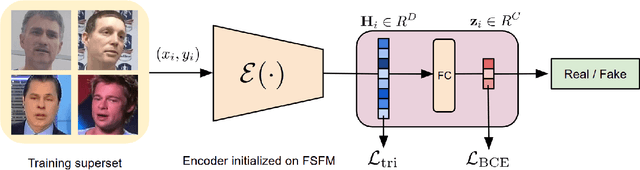
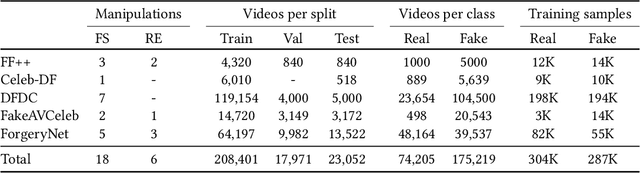
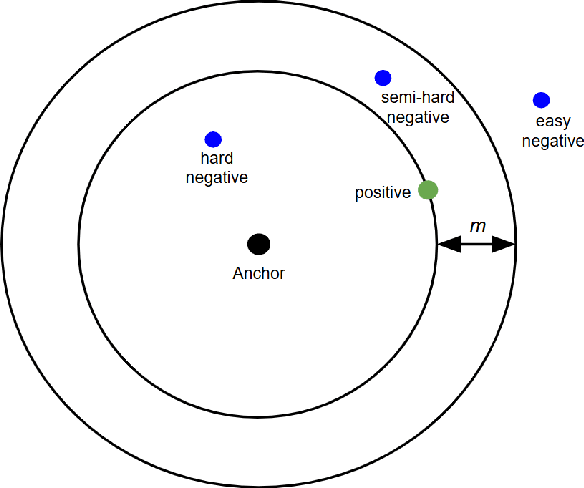
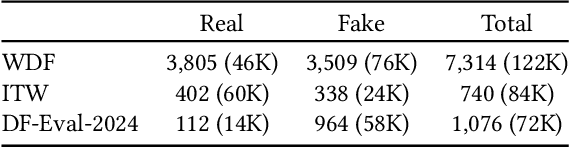
The increasing realism and accessibility of deepfakes have raised critical concerns about media authenticity and information integrity. Despite recent advances, deepfake detection models often struggle to generalize beyond their training distributions, particularly when applied to media content found in the wild. In this work, we present a robust video deepfake detection framework with strong generalization that takes advantage of the rich facial representations learned by face foundation models. Our method is built on top of FSFM, a self-supervised model trained on real face data, and is further fine-tuned using an ensemble of deepfake datasets spanning both face-swapping and face-reenactment manipulations. To enhance discriminative power, we incorporate triplet loss variants during training, guiding the model to produce more separable embeddings between real and fake samples. Additionally, we explore attribution-based supervision schemes, where deepfakes are categorized by manipulation type or source dataset, to assess their impact on generalization. Extensive experiments across diverse evaluation benchmarks demonstrate the effectiveness of our approach, especially in challenging real-world scenarios.
Robust Deepfake Detection for Electronic Know Your Customer Systems Using Registered Images
Jul 30, 2025In this paper, we present a deepfake detection algorithm specifically designed for electronic Know Your Customer (eKYC) systems. To ensure the reliability of eKYC systems against deepfake attacks, it is essential to develop a robust deepfake detector capable of identifying both face swapping and face reenactment, while also being robust to image degradation. We address these challenges through three key contributions: (1)~Our approach evaluates the video's authenticity by detecting temporal inconsistencies in identity vectors extracted by face recognition models, leading to comprehensive detection of both face swapping and face reenactment. (2)~In addition to processing video input, the algorithm utilizes a registered image (assumed to be genuine) to calculate identity discrepancies between the input video and the registered image, significantly improving detection accuracy. (3)~We find that employing a face feature extractor trained on a larger dataset enhances both detection performance and robustness against image degradation. Our experimental results show that our proposed method accurately detects both face swapping and face reenactment comprehensively and is robust against various forms of unseen image degradation. Our source code is publicly available https://github.com/TaikiMiyagawa/DeepfakeDetection4eKYC.
Celeb-DF++: A Large-scale Challenging Video DeepFake Benchmark for Generalizable Forensics
Jul 24, 2025The rapid advancement of AI technologies has significantly increased the diversity of DeepFake videos circulating online, posing a pressing challenge for \textit{generalizable forensics}, \ie, detecting a wide range of unseen DeepFake types using a single model. Addressing this challenge requires datasets that are not only large-scale but also rich in forgery diversity. However, most existing datasets, despite their scale, include only a limited variety of forgery types, making them insufficient for developing generalizable detection methods. Therefore, we build upon our earlier Celeb-DF dataset and introduce {Celeb-DF++}, a new large-scale and challenging video DeepFake benchmark dedicated to the generalizable forensics challenge. Celeb-DF++ covers three commonly encountered forgery scenarios: Face-swap (FS), Face-reenactment (FR), and Talking-face (TF). Each scenario contains a substantial number of high-quality forged videos, generated using a total of 22 various recent DeepFake methods. These methods differ in terms of architectures, generation pipelines, and targeted facial regions, covering the most prevalent DeepFake cases witnessed in the wild. We also introduce evaluation protocols for measuring the generalizability of 24 recent detection methods, highlighting the limitations of existing detection methods and the difficulty of our new dataset.
AV-Deepfake1M++: A Large-Scale Audio-Visual Deepfake Benchmark with Real-World Perturbations
Jul 28, 2025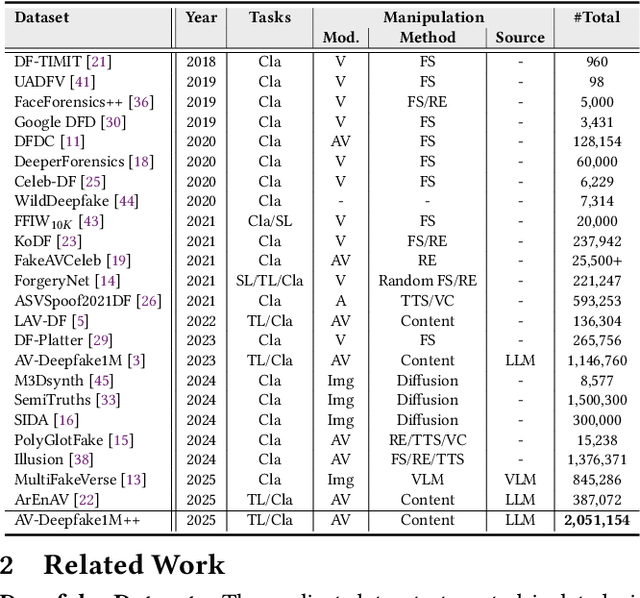
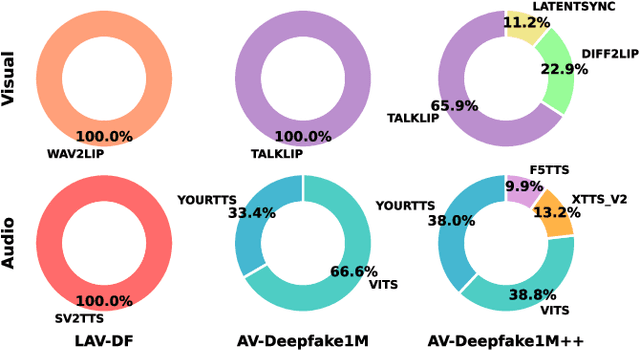
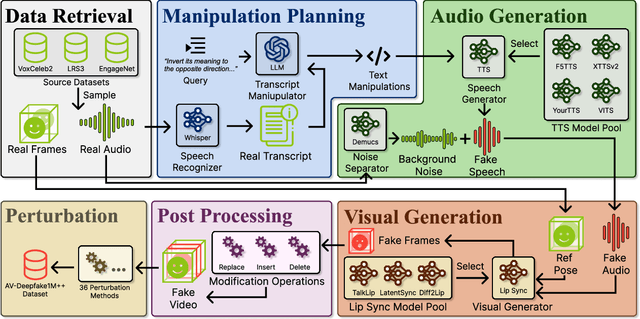
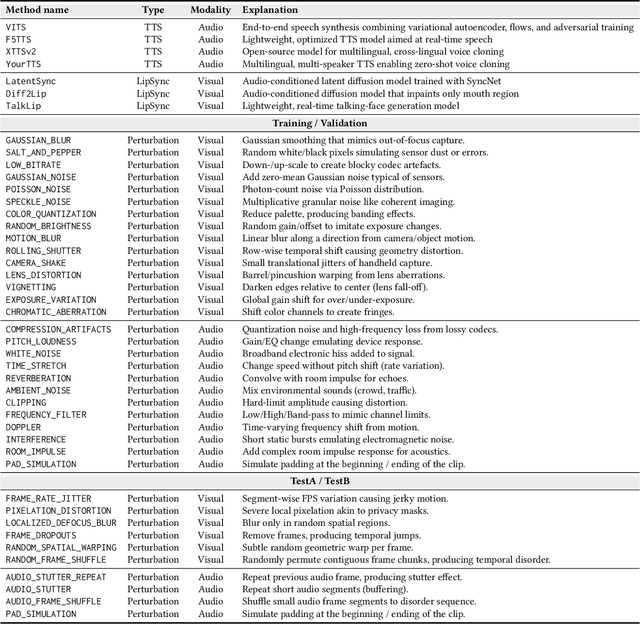
The rapid surge of text-to-speech and face-voice reenactment models makes video fabrication easier and highly realistic. To encounter this problem, we require datasets that rich in type of generation methods and perturbation strategy which is usually common for online videos. To this end, we propose AV-Deepfake1M++, an extension of the AV-Deepfake1M having 2 million video clips with diversified manipulation strategy and audio-visual perturbation. This paper includes the description of data generation strategies along with benchmarking of AV-Deepfake1M++ using state-of-the-art methods. We believe that this dataset will play a pivotal role in facilitating research in Deepfake domain. Based on this dataset, we host the 2025 1M-Deepfakes Detection Challenge. The challenge details, dataset and evaluation scripts are available online under a research-only license at https://deepfakes1m.github.io/2025.